Automation has become an important part of modern business operations. Companies use it to complete tasks faster, maintain consistent quality, reduce manual errors, and control operating costs. However, not every automation system works in the same way.
Traditional automation follows a fixed set of instructions. It performs well when tasks are repetitive and the rules rarely change. AI automation goes a step further by analysing data, recognising patterns, and responding to situations that may not have been programmed in advance.
Interest in AI Automation Services in India is increasing across customer service, finance, healthcare, manufacturing, logistics, retail, and administration. Meanwhile, AI Integration Services in India enable businesses to introduce these intelligent capabilities into their existing software, databases, cloud applications, and internal workflows.
Choosing between the two does not mean deciding that one technology is always better. The right option depends on the process, available data, expected results, and level of human oversight required.
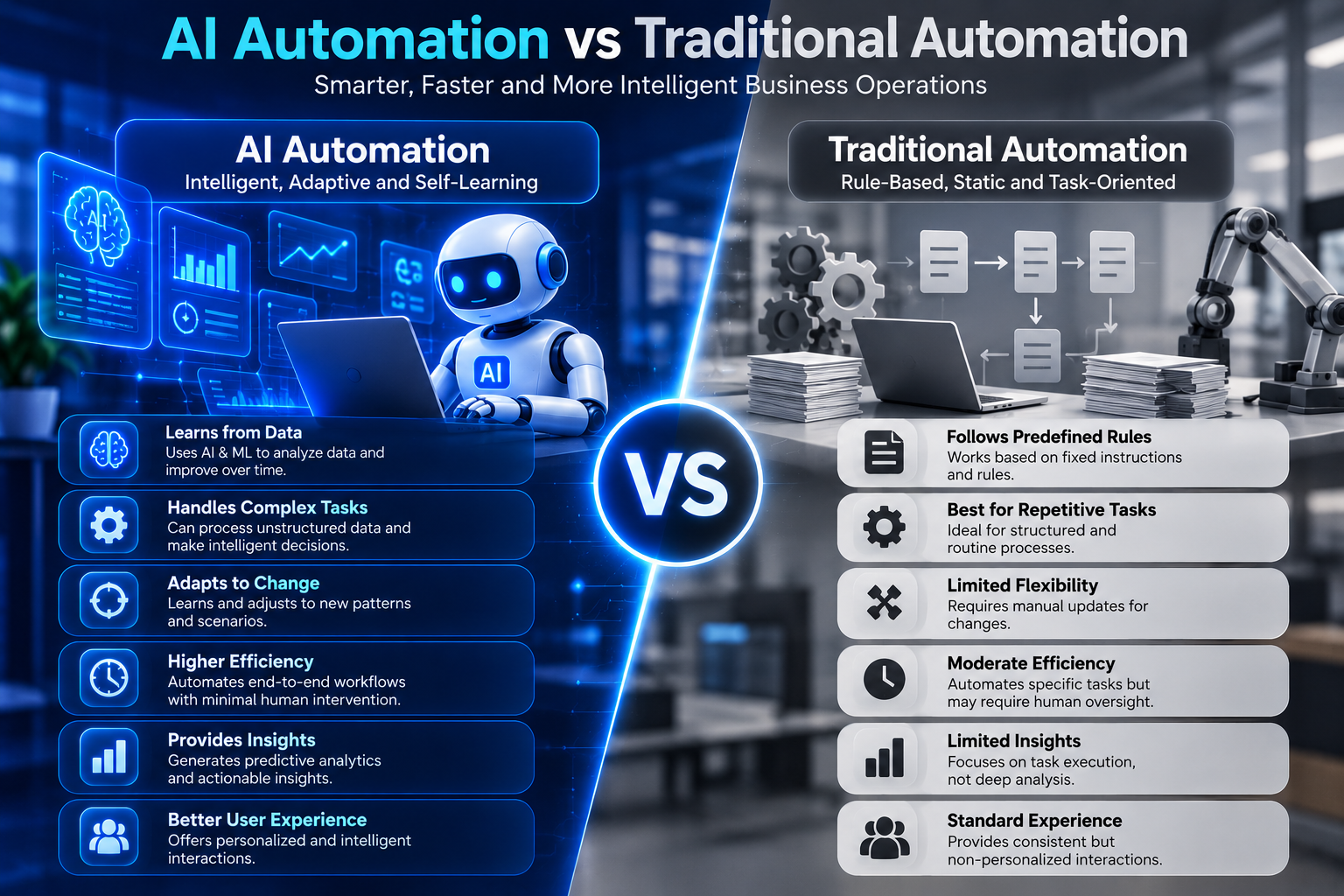
Traditional automation uses predefined instructions to complete predictable tasks. A developer or process specialist decides which action the system should take when a particular condition is met.
For example, a system may automatically send an invoice when an order is confirmed, generate a report at the end of each month, or approve a request when it meets specified conditions.
This approach works particularly well when:
Traditional automation is reliable because it produces the same result whenever it receives the same input. It is also generally easier to test, monitor, and audit. Its main limitation is that it cannot understand unfamiliar information or adjust its behaviour without being manually reprogrammed.
AI automation combines automated workflows with technologies such as machine learning, natural language processing, predictive analytics, computer vision, and generative AI.
Instead of depending entirely on fixed instructions, an AI-powered system can examine information, identify patterns, estimate possible outcomes, and recommend an appropriate action.
Common uses of AI Automation Services in India include document processing, customer-support assistants, fraud detection, demand forecasting, visual quality inspection, lead prioritisation, and predictive equipment maintenance.
For these tools to work within daily business operations, AI Integration Services in India connect them with CRM platforms, ERP systems, websites, mobile applications, communication channels, and data warehouses.
AI automation does not operate without rules. Reliable systems normally combine AI models with business policies, approval processes, security controls, and human review.
The key difference lies in how the two approaches process information and respond to change.
| Area | Traditional Automation | AI Automation |
|---|---|---|
| Working method | Follows predefined rules | Uses learned patterns and rules |
| Type of data | Mainly structured data | Structured and unstructured data |
| Adaptability | Requires manual updates | Can improve with updated data |
| Decision-making | Fixed and deterministic | Predictive or probability-based |
| Explainability | Usually easy to explain | Depends on the model used |
| Best suited for | Stable, repetitive processes | Variable and data-heavy processes |
| Monitoring | Focuses on exceptions | Requires continuous evaluation |
Traditional automation gives a fixed output for a defined input. AI automation may instead generate a prediction, classification, summary, recommendation, or probability.
That flexibility makes AI useful for more complex processes. It also creates additional responsibilities related to data quality, accuracy, security, bias, monitoring, and responsible decision-making.
AI automation allows software to support tasks that once required significant manual interpretation. Its main benefits include:
Businesses considering AI Automation Services in India should begin with a specific operational problem. Every project should have a measurable goal, such as reducing processing time, improving forecast accuracy, lowering error rates, or increasing service availability.
Traditional automation is often the more practical option when the workflow is stable and every decision can be explained through clear rules.
Payroll calculations, scheduled notifications, data validation, file transfers, routine approvals, and standard report generation usually do not require artificial intelligence. Adding AI to such processes may increase costs and maintenance requirements without delivering a meaningful advantage.
Traditional automation may also be preferred when full predictability and detailed audit trails are essential.
Before selecting a technology, examine the process and ask:
Choose traditional automation for stable, rule-based processes. Consider AI Automation Services in India when the work involves interpretation, prediction, personalisation, or unstructured information.
Use AI Integration Services in India when AI tools must exchange information securely with existing business platforms. In many situations, a hybrid approach is the most practical choice. Traditional rules can manage routine steps and compliance controls, while AI handles complex information and recommendations.
Traditional automation follows fixed instructions. AI automation uses data and intelligent models to interpret information, recognise patterns, and predict possible outcomes.
Processes involving documents, conversations, images, forecasting, personalisation, anomaly detection, or frequent exceptions may benefit from AI automation.
Yes. Small businesses can begin with focused applications such as enquiry classification, invoice data extraction, customer-support assistance, or inventory forecasting.
They may include data assessment, API development, model integration, workflow configuration, security controls, testing, deployment, performance monitoring, and connections with CRM, ERP, cloud, or communication platforms.
AI automation can involve higher initial and ongoing costs because it requires data preparation, model evaluation, monitoring, security, and governance. The overall value depends on the complexity and volume of the process.
Yes. Many businesses use traditional automation for predictable steps and AI for tasks that require interpretation, forecasting, or recommendations.
Useful measures include processing time, accuracy, error rates, cost per transaction, exception frequency, employee effort, customer satisfaction, system availability, and return on investment.


 Home
Home