Artificial intelligence is no longer limited to experiments or separate innovation projects. It is becoming part of everyday business operations. AI integration services in India help companies connect AI capabilities with the applications, databases, cloud platforms, and workflows they already use. The purpose is not to add AI simply because it is available. It is to make useful information and automation accessible to employees and customers at the right time.
These services can support document processing, customer service, demand forecasting, fraud detection, predictive maintenance, and business reporting. They also address less visible but equally important requirements, including data preparation, system compatibility, security, governance, and performance monitoring.
For Indian businesses, successful adoption depends on selecting practical use cases and introducing them without disrupting essential work. Careful planning can improve efficiency, support quicker decisions, and create more consistent customer experiences.
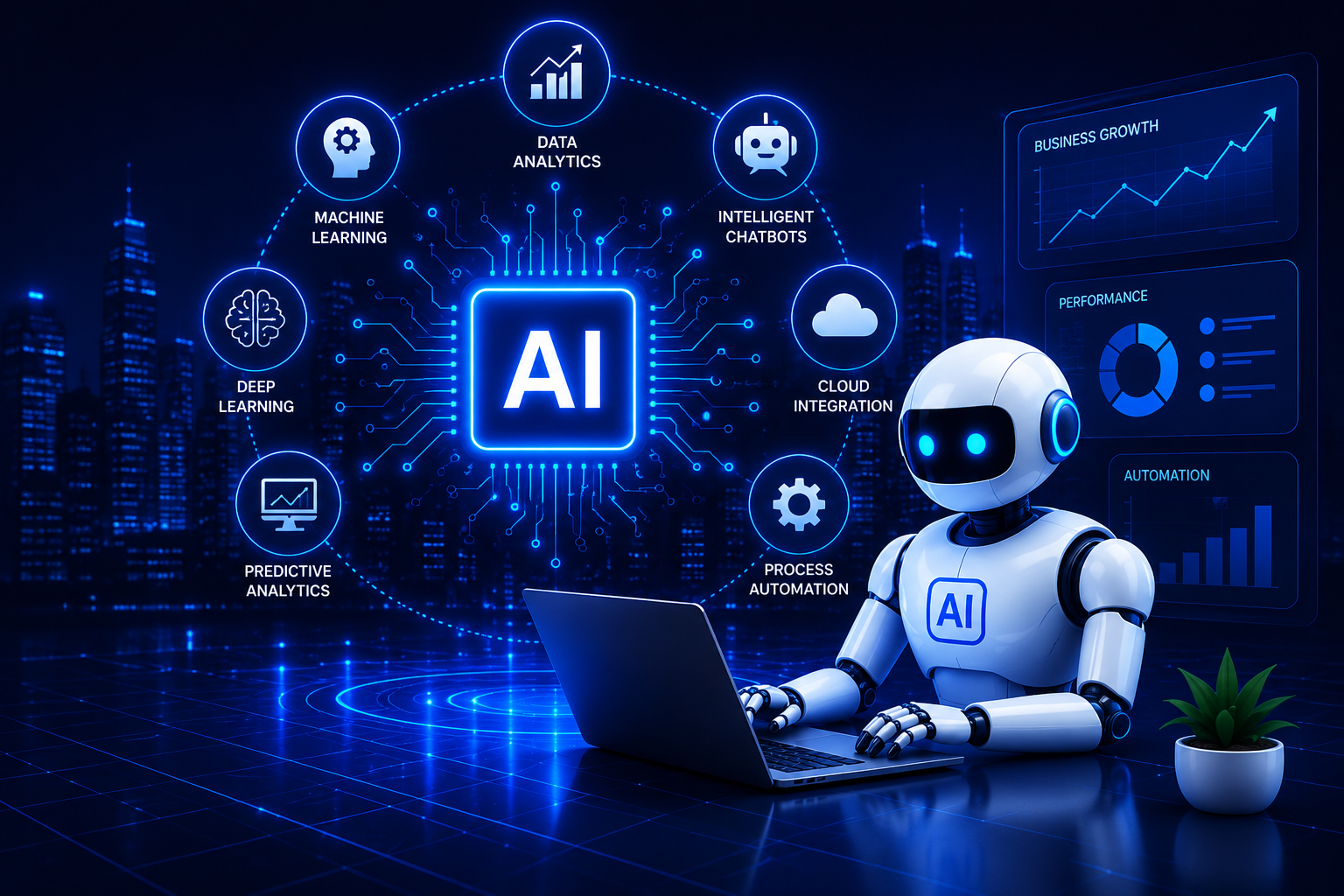
AI integration connects artificial intelligence models and features with a company’s existing technology environment. Depending on the business, this may involve an ERP platform, CRM software, website, mobile application, data warehouse, internal communication system, or industrial equipment.
AI integration services in India usually cover business assessment, data preparation, model selection, API development, workflow design, testing, deployment, and monitoring. A company may choose an established AI platform, adapt a pretrained model, or build a specialized system.
The right approach depends on the problem being solved. A customer-service assistant, for example, requires a different setup from a fraud-detection system or a predictive-maintenance tool.
A typical implementation includes:
Reliable AI integration services in India treat deployment as the beginning of an ongoing process. Models require regular reviews because customer behaviour, market conditions, source data, internal processes, and regulatory expectations can change.
A system that worked accurately six months ago may become less dependable if the information feeding it has changed. Regular testing helps identify these issues before they affect employees or customers.
Greater Operational Efficiency
Many business processes involve repetitive tasks such as sorting emails, extracting information from invoices, updating records, or routing support requests. AI can handle much of this work, giving employees more time for tasks that require judgement, communication, or specialist knowledge.
Faster, Better-Informed Decisions
Integrated AI can review large volumes of information and identify patterns that may be difficult to notice manually. Managers can use forecasts, risk scores, and real-time alerts alongside their own knowledge when making decisions. The technology does not replace professional judgement. It helps people reach relevant information sooner.
More Consistent Customer Service
AI assistants can answer common questions, summarize conversations, and direct complex enquiries to the appropriate employee. When connected to an accurate and regularly updated knowledge base, they can provide consistent information across different service channels. Human support should remain available when a request is sensitive, unusual, or too complex for automated handling.
Improved Risk Detection
AI systems can monitor transactions, network activity, equipment readings, and user behaviour for unusual patterns. Early warnings can help teams investigate possible fraud, cybersecurity incidents, equipment failures, or compliance problems before they become more serious.
Poor data quality is one of the most common reasons an AI project underperforms. Missing, duplicated, outdated, or biased data can lead to unreliable outputs. Older business systems may also lack suitable interfaces, making secure integration more difficult.
Other challenges include privacy, cybersecurity, employee acceptance, model accuracy, explainability, vendor dependence, and unexpected computing costs. Generative AI may produce convincing but incorrect information. Any output affecting finances, safety, compliance, employment, or customer rights should therefore be reviewed by an appropriate person.
Experienced AI integration services in India address these risks through access controls, data checks, structured testing, audit logs, fallback procedures, and clearly assigned responsibilities. Governance should be included from the planning stage rather than added after deployment.
Employees also need to understand what the system can and cannot do. Training should cover normal use, warning signs, escalation procedures, and the correct handling of sensitive information.
Begin with a clearly defined business problem instead of choosing a tool first. Identify who will use the system, what data is available, which outcome is expected, what level of error is acceptable, and how performance will be measured.
A small pilot is often useful because it allows the business to test assumptions before committing to a wider rollout.
Evaluate whether the proposed approach offers:
Organizations comparing AI integration services in India should clarify who owns the data, custom code, prompts, outputs, and integration components. Contracts should also cover service levels, security responsibilities, incident reporting, support arrangements, and exit procedures.
1. What are AI integration services?
They connect AI models with existing applications, data sources, and workflows so businesses can use artificial intelligence within their normal operations.
2. How can AI integration help a business?
It can reduce repetitive work, improve forecasting, support employees, personalize customer experiences, identify risks, and make business information easier to use.
3. Which industries use AI integration services in India?
Banking, healthcare, retail, manufacturing, logistics, education, telecommunications, professional services, and public-sector organizations use AI integration for various operational and analytical purposes.
4. How long does an AI integration project take?
A focused pilot may take several weeks. A complex enterprise implementation can take several months, depending on data readiness, system compatibility, security, and testing requirements.
5. Is AI integration secure?
AI integration can be secure when it includes encryption, controlled access, data minimization, vendor reviews, audit logging, continuous monitoring, and appropriate human oversight.
For comprehensive AI integration solutions, please visit AI Integration Services India.


 Home
Home