AI integration Services in India help businesses make artificial intelligence work with the software, data, and processes they already use. In practice, that might mean reading invoices automatically, sorting customer enquiries, or bringing useful information into a manager's dashboard. As data volumes grow and daily operations become more complex, AI is moving beyond trial projects and into business use.
AI Automation Services in India bring together machine learning, language processing, document recognition, conversational AI, and workflow automation. Their uses extend across finance, sales, customer service, human resources, manufacturing, logistics, and cybersecurity. The point is not to remove people from every process. It is to reduce routine administration so employees have more time for judgement, problem-solving, and customers. Whether that works depends on the quality of the data, the chosen task, integration, employee adoption, governance, and regular review.
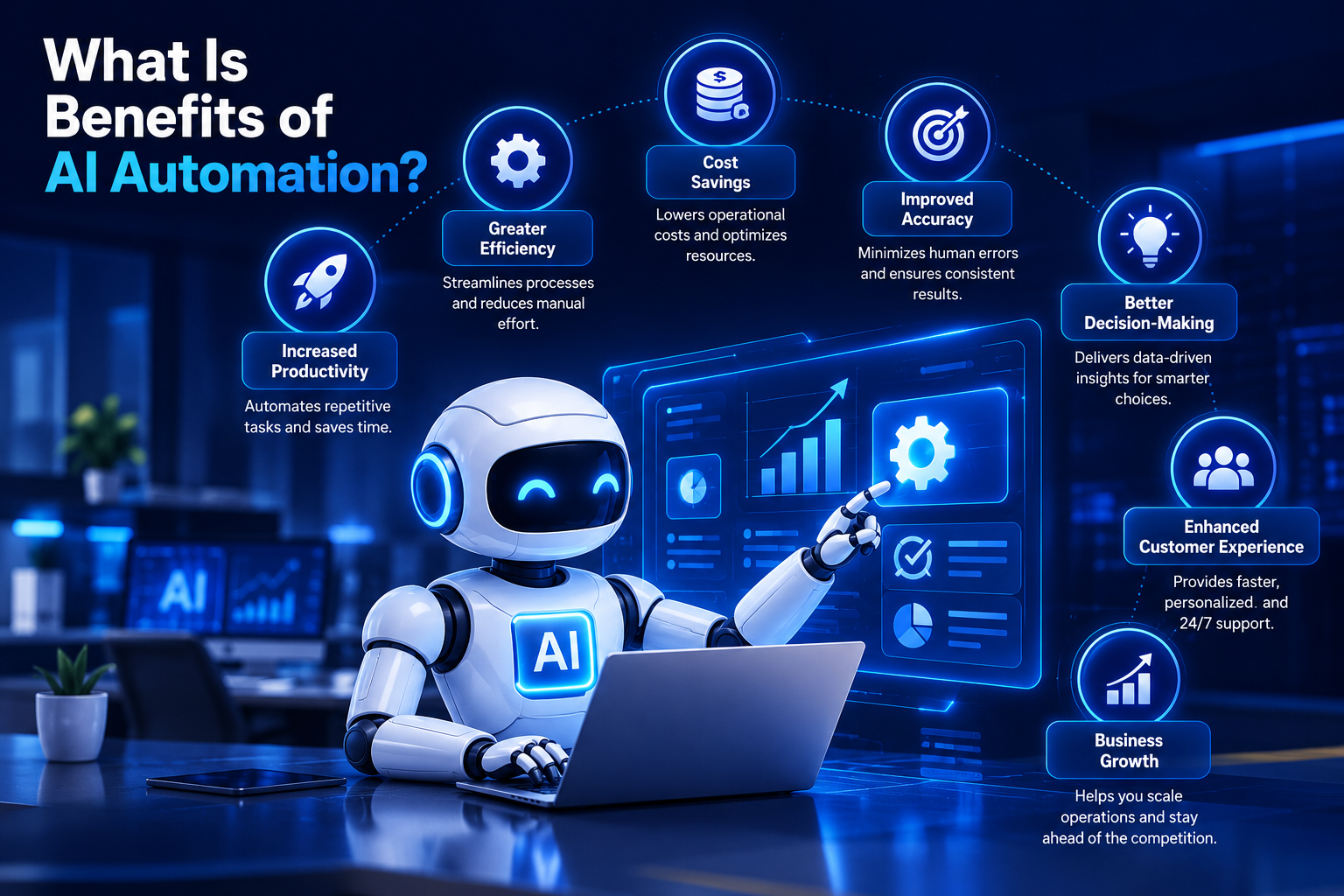
AI automation uses artificial intelligence to complete tasks, interpret information, suggest actions, or keep a workflow moving with limited intervention. Conventional automation follows a fixed instruction: if one event happens, perform a defined action. An AI-enabled system can also classify a document, recognise patterns, interpret language, draft a response, or make a recommendation from the available data.
AI integration Services in India connect these capabilities with enterprise planning, customer relationship management, help-desk, analytics, communication, and industry-specific platforms used daily.
Employees spend time copying information, checking documents, preparing routine reports, and moving requests between systems. AI automation can handle predictable parts of this work reliably.
Reduced manual processing shortens turnaround times and helps teams manage higher workloads without increasing administrative effort. Employees remain responsible for exceptions, approvals, and decisions requiring context or accountability.
Automation can reduce costs associated with repetitive labour, rework, delays, and avoidable errors. It can also help organisations use systems by connecting fragmented workflows.
Cost savings should be measured against implementation, integration, infrastructure, training, maintenance, and governance expenses. AI Automation Services in India are most valuable when applied to frequent, rules-supported processes with measurable outcomes.
Manual data entry and repetitive reviews are vulnerable to fatigue and inconsistency. AI can validate fields, compare records, detect missing information, and apply the same review criteria across work.
Human review is necessary where decisions affect rights, safety, employment, credit, healthcare, or regulatory obligations. The objective is controlled assistance, not unquestioned machine output.
AI integration Services in India can bring insights directly into the applications employees already use, reducing the delay between analysis and action.
Customers expect timely and accurate support across websites, messaging services, email, and telephone channels. AI assistants can answer common questions, collect initial details, identify intent, and route complex cases to appropriate employees.
Automation can also personalise recommendations and provide status updates. Clear escalation to a person remains essential when a request is sensitive, unusual, disputed, or emotionally complex.
AI automation can reduce administrative workload by preparing meeting summaries, drafting routine responses, locating internal information, and organising incoming requests. This gives employees more time for relationship management, creative work, analysis, and problem-solving.
Organisations should involve employees when redesigning workflows. Their practical knowledge helps identify exceptions, hidden dependencies, and steps that should not be automated.
Manual processes may become difficult to manage when transaction volumes rise. Automated workflows can process larger workloads during seasonal demand, business expansion, or rapid customer growth.
AI Automation Services in India can support scalability across departments, provided infrastructure, data access, monitoring, and exception handling are designed for increased volume.
Successful implementation starts with a specific business problem. Organisations should document the current process, establish baseline performance, identify responsible owners, and define what improvement will be measured.
A practical implementation framework includes:
AI integration Services in India should also incorporate access controls, audit logs, encryption, vendor assessment, and incident-response processes.
They are services that use artificial intelligence to automate tasks, decisions, document processing, customer interactions, and workflows within business systems.
Traditional automation follows predefined rules. AI automation can interpret language, recognise patterns, classify information, generate content, and support decisions using data.
Businesses of different sizes can use it. Suitability depends on process volume, data quality, integration requirements, risk, budget, and expected value.
They may use APIs, connectors, middleware, databases, and workflow platforms to exchange information between AI tools and existing business applications.
It can reduce manual processing, delays, rework, and errors. Actual savings depend on implementation costs, process suitability, adoption, maintenance, and achieved performance.
Security depends on the design. Appropriate controls include restricted access, encryption, data minimisation, audit logs, vendor reviews, monitoring, and incident response.
Some tasks may change or disappear, but many implementations assist employees rather than replace entire roles. Workforce planning and reskilling are important.
Start with a repetitive, measurable, lower-risk process that has reliable data, clear ownership, and enough volume to justify implementation.


 Home
Home