Data loss prevention and data backup are often discussed as though they do the same job. They do not. Both protect business information, but they step in at different moments and solve different problems. Data loss prevention services in India help businesses identify sensitive information, understand how employees and applications use it, and prevent it from leaving approved systems. Backup solutions create separate copies that can be recovered when original data is deleted, corrupted, encrypted, or destroyed.
This difference matters for any organization handling customer details, financial records, employee files, medical information, intellectual property, or confidential contracts. Data loss protection services in India are mainly concerned with keeping information private and controlling its movement. Backup is concerned with making information available again after something goes wrong.
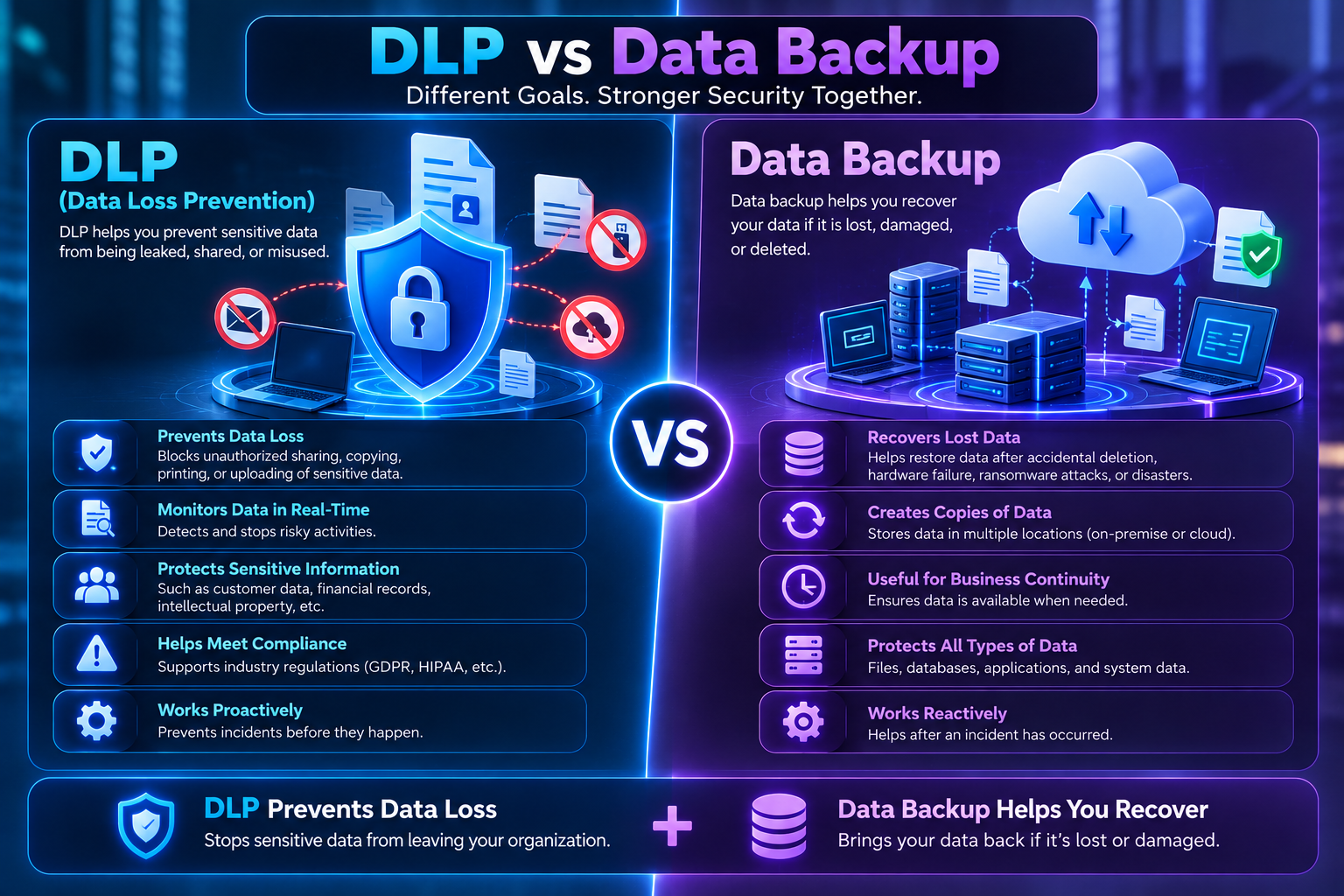
Data loss prevention, commonly called DLP, is a security approach that discovers, classifies, monitors, and protects sensitive information. It uses policies to decide what users can do with particular types of data. These decisions may depend on the content, user, device, application, destination, or activity involved.
DLP generally monitors information in three states:
Data backup is the practice of making recoverable copies of important information. Those copies may be stored on local infrastructure, in another data centre, on a cloud platform, or on offline media isolated from the primary network.
A reliable backup arrangement helps businesses recover from:
DLP tries to prevent sensitive information from being exposed, misused, or transferred without permission. Backup preserves copies so information can be recovered. Data loss protection services in India support confidentiality, while backup primarily supports availability and continuity.
DLP responds before or during a risky action. It might block a file upload, restrict printing, or alert the security team when unusual copying occurs. Backup becomes useful after data has already been deleted, damaged, encrypted, or made unavailable.
DLP addresses careless sharing, insider threats, unauthorized transfers, policy violations, and confidential-data exposure. Backup addresses human error, technical failure, malware damage, storage faults, and physical disasters.
DLP solutions in India may use content inspection, digital fingerprinting, classification labels, user-behaviour analysis, and automated policy enforcement. Backup platforms rely on replication, snapshots, versioning, retention schedules, immutable storage, and structured recovery workflows.
Data loss prevention services in India examine how information is handled during normal work. Depending on the policy, the system can display a warning, request a business justification, encrypt a document, quarantine an attachment, block a transfer, or notify the security team. Backup tools generally do not decide whether sharing a file is appropriate.
Together, they create a complete information security framework.
A sound backup strategy keeps multiple protected copies, separates critical backups from production systems, sets practical retention periods, and tests restoration regularly. Data loss protection services in India strengthen that strategy by reducing the chance that sensitive information will be leaked during daily operations.
A balanced approach should include:
When DLP solutions in India operate alongside a tested backup system, businesses can protect confidentiality, integrity, and availability without expecting either control to perform a job it was never designed to do.
DLP controls how sensitive information is accessed and shared. Backup creates recoverable copies for use after deletion, corruption, system failure, or an attack.
No. Cloud backup can restore files, but it usually cannot stop an employee from sending, printing, copying, or uploading confidential information without approval.
DLP may detect unusual data movement, but it is not a complete ransomware defence. Endpoint security, access controls, patching, monitoring, and immutable backups remain necessary.
DLP can protect personal details, payment information, medical records, financial documents, contracts, credentials, source code, trade secrets, and other confidential business files.
It should consider data locations, legal obligations, cloud usage, endpoint coverage, integrations, policy accuracy, reporting, scalability, and the effort required to investigate alerts.
Usually not. Many requirements also cover access control, monitoring, breach prevention, retention, secure deletion, and incident reporting.
Organizations should schedule regular restoration exercises and review DLP policies whenever their applications, workflows, data types, risks, or regulatory duties change.


 Home
Home