Sensitive business information rarely stays in one place. During a normal working day, employees may access customer records from laptops, send reports by email, collaborate through cloud applications, upload documents to shared drives, or use AI tools to complete routine tasks.
Each activity is useful, but each one also creates an opportunity for information to be shared with the wrong person or transferred through an unsafe channel. A confidential attachment may be sent to a personal email address, a cloud folder may be left publicly accessible, or an employee may copy sensitive information onto an unapproved device.
Data loss prevention services in India help organisations identify these risks and control how confidential information is accessed, used, and shared. They can protect personal details, financial records, healthcare information, customer credentials, intellectual property, business plans, and source code.
Data loss protection services in India are not designed simply to block every file transfer. A properly planned DLP programme considers the type of information involved, the person using it, the intended destination, and the business reason behind the activity. This allows organisations to protect important data without creating unnecessary disruption for employees.
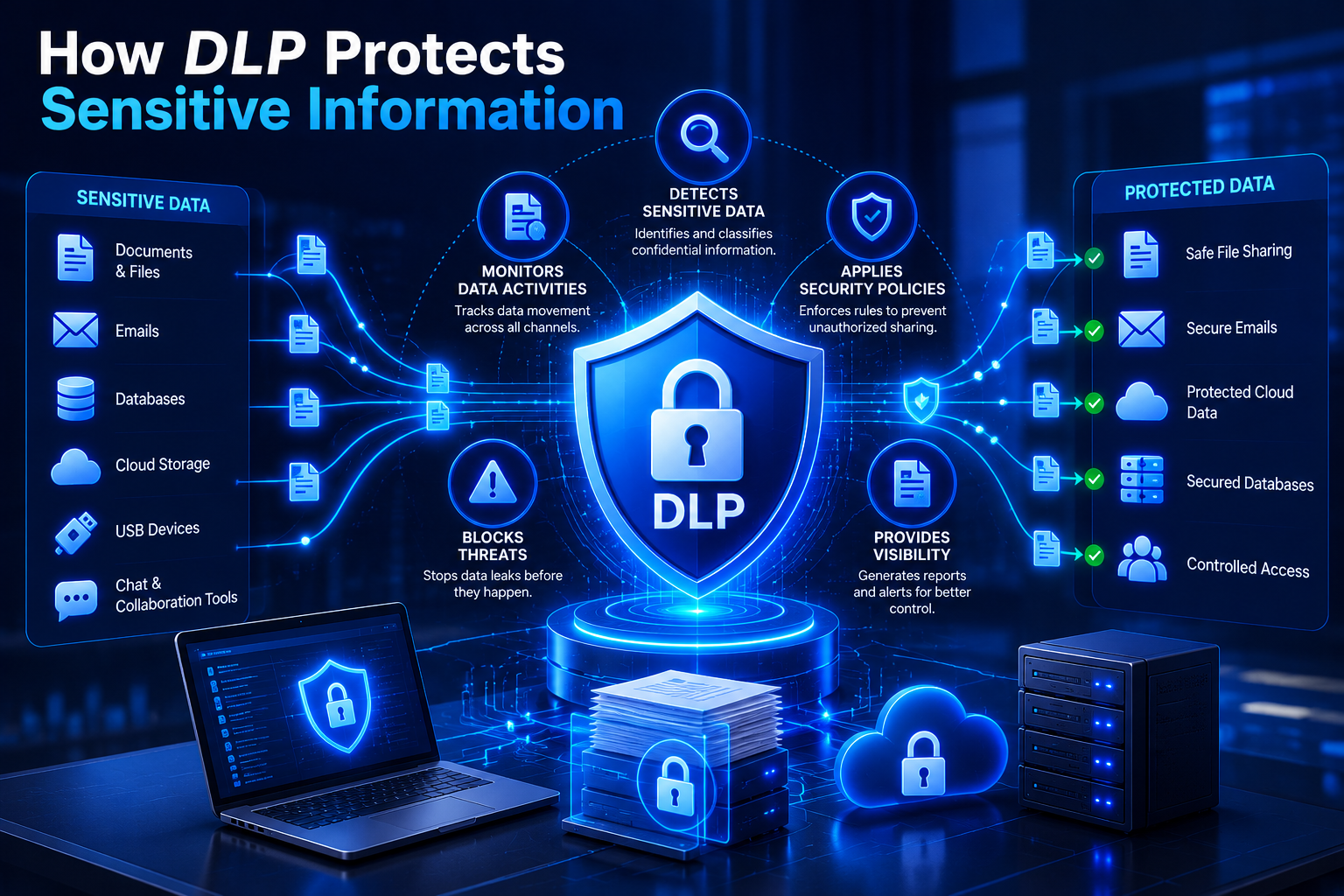
Data loss prevention, commonly called DLP, is a security approach used to prevent sensitive information from being exposed, leaked, altered, or transferred without permission.
DLP technologies inspect content and analyse its context. They may use classification labels, access permissions, pattern matching, encryption, and user activity to determine whether an action is safe.
Most DLP solutions in India protect information in three different states:
Protecting all three states matters because data can be exposed while stored, while travelling between systems, or while someone is actively working with it.
An organisation cannot protect sensitive information unless it knows where that information is stored. Data discovery and classification are therefore among the first steps in any DLP programme.
DLP solutions in India scan structured information, such as database records, and unstructured information, such as documents, spreadsheets, presentations, emails, and images.
Common identification methods include:
Once information has been classified, different rules can be applied according to its sensitivity, owner, location, and permitted use.
DLP works at the moment a potentially unsafe action occurs. It examines the file or message, where it is being sent, who is sending it, which device or application is involved, and whether the action complies with company policy.
The system may allow the activity, display a warning, request justification, apply encryption, quarantine the file, alert the security team, or block the transfer.
For example, an employee may accidentally attach a customer database to an email addressed to an external contact. A DLP policy can recognise the sensitive records and stop the email before it is delivered.
Data loss prevention services in India can also prevent employees from:
The aim is to intervene when genuine risk is present while allowing ordinary, authorised work to continue.
Many data incidents begin with an everyday mistake rather than a deliberate attack. An employee may choose the wrong email recipient, attach an outdated document, or apply incorrect permissions to a shared folder.
Real-time warnings give employees an opportunity to review the action before the information leaves the organisation.
Employees, contractors, or business partners may intentionally collect confidential information for personal, financial, or competitive reasons.
DLP solutions in India can identify unusual activities such as mass downloads, repeated policy violations, large file transfers, and copying documents to personal storage accounts or removable devices.
Employees now access business information from offices, homes, client locations, and mobile devices. Sensitive data also moves regularly between cloud storage, SaaS applications, email systems, and collaboration platforms.
Data loss protection services in India extend security policies beyond the traditional office network and help organisations maintain consistent controls across supported devices and cloud environments.
Indian organisations may be responsible for protecting personal information under the Digital Personal Data Protection Act, sector-specific regulations, contracts, and internal governance policies.
DLP supports these responsibilities by helping organisations:
DLP is an important technical control, but it does not provide compliance on its own. Organisations also need appropriate governance, employee training, legal guidance, access management, and incident-response procedures.
A practical DLP programme should begin with the information that would cause the most harm if exposed. Trying to monitor or block everything immediately often creates excessive alerts and disrupts legitimate work.
A phased implementation generally includes:
Effective Data loss prevention services in India should also work with identity systems, endpoint security, email platforms, cloud applications, SIEM tools, and incident-response workflows.
DLP can protect personal information, financial records, payment details, medical data, login credentials, contracts, intellectual property, source code, and other confidential business information.
They discover and classify sensitive information, monitor how it is used, compare user activities with security policies, and warn or block unsafe transfers.
Yes. DLP can inspect email content and attachments. If sensitive information is being sent to an unauthorised recipient, the system can block, quarantine, or encrypt the message.
Modern DLP tools can monitor supported cloud storage services, SaaS platforms, collaboration applications, browser uploads, and shared links. Coverage depends on the selected technology and its integrations.
Requirements vary according to the organisation, industry, contracts, and information being processed. DLP can support privacy and security compliance, but businesses should obtain appropriate legal and regulatory guidance.
Encryption makes information unreadable without the correct key. DLP identifies sensitive information and controls how it may be accessed, copied, or transferred. The two controls serve different purposes and are often used together.
Yes. A small business can begin by protecting its most valuable information and monitoring high-risk channels such as email, cloud storage, external uploads, and removable devices.


 Home
Home