Growing businesses depend on websites, cloud platforms, email, digital payments, customer databases, and connected devices to manage everyday operations. These technologies make expansion easier, but they also create more opportunities for cybercriminals to access sensitive information or disrupt essential services.
Cybersecurity is therefore more than an IT responsibility. It directly affects business continuity, financial stability, legal compliance, and customer trust.
As companies expand, cybersecurity services in India help them identify vulnerabilities, secure critical systems, monitor unusual activity, and respond effectively to security incidents. This support is particularly valuable for startups and small and medium-sized businesses that manage sensitive data without having a large internal cybersecurity team.
A practical cybersecurity strategy should combine appropriate technology, employee awareness, documented procedures, and regular security testing. This allows business leaders to invest according to genuine risks instead of taking action only after an incident has occurred.
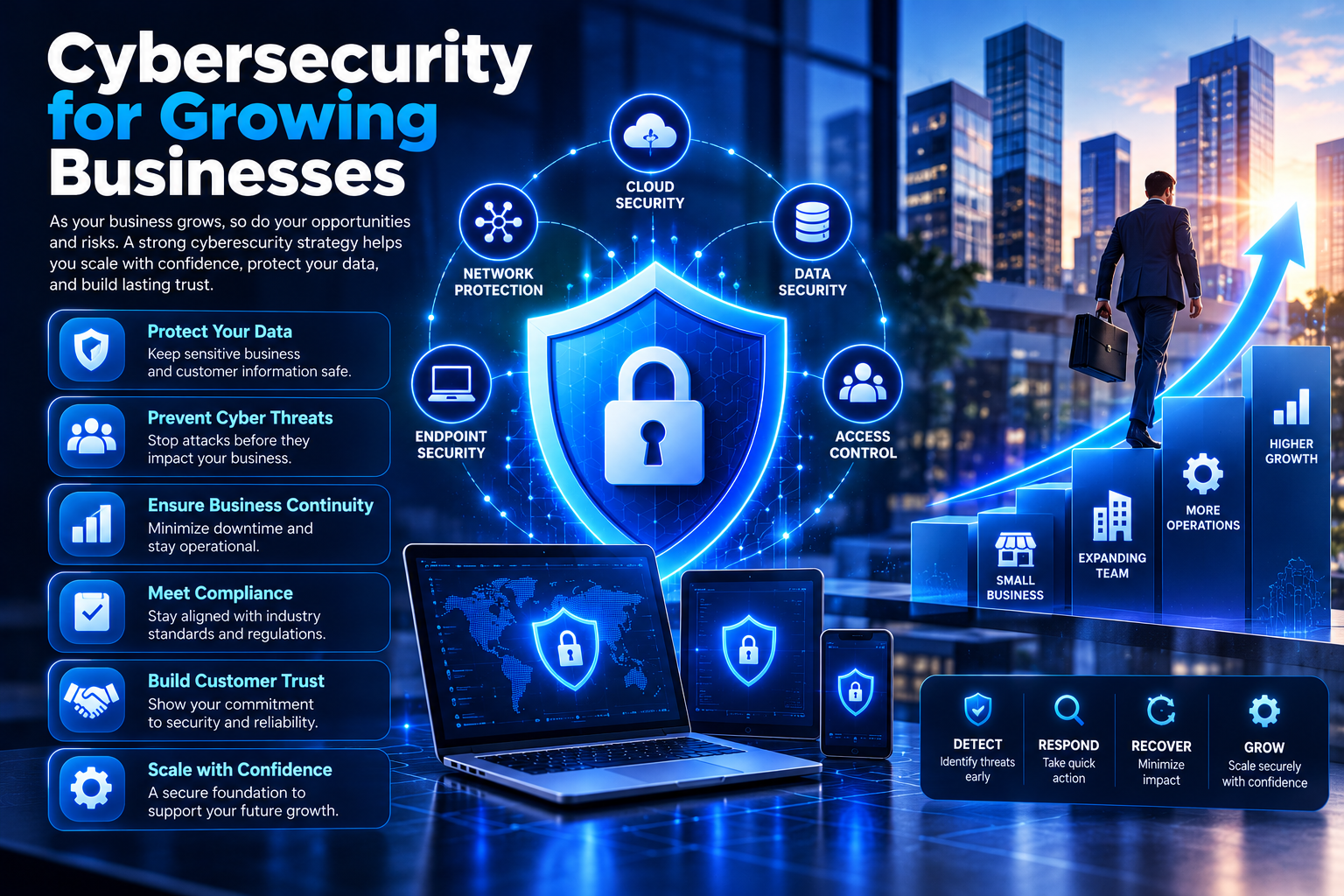
Business growth usually brings more employees, customers, devices, applications, vendors, and data. Each new account, device, or third-party connection can become a potential entry point when it is configured incorrectly or left unmonitored.
Growing teams also tend to adopt new applications quickly to meet operational demands. Without a proper security review, this can result in weak passwords, unnecessary user permissions, outdated software, exposed cloud storage, or unauthorised applications.
Smaller organisations are often targeted because cybercriminals expect their security controls to be less developed than those of larger enterprises.
Working with cybersecurity services in India can help businesses understand their expanding attack surface and address the most serious weaknesses first. The aim is not to eliminate every possible threat, which is rarely realistic, but to reduce risk to an acceptable and manageable level.
A cyberattack can interrupt sales, customer support, production, deliveries, and financial operations. Even a short period of disruption may result in lost revenue, recovery expenses, contractual penalties, and customer complaints.
A data breach may also expose personal, financial, medical, or commercially sensitive information. The affected company may need to investigate the incident, notify customers and stakeholders, restore systems, seek legal advice, and meet applicable regulatory requirements.
The reputational impact can continue long after technical systems have been restored. Customers may hesitate to share information or continue doing business with a company if they believe their personal data was not adequately protected.
Using cybersecurity services in India cannot guarantee that an organisation will never experience an attack. However, suitable protection and monitoring can reduce the likelihood of a successful breach and improve the organisation’s ability to detect, contain, and recover from an incident.
Businesses that prepare in advance generally recover faster and communicate more effectively with customers, employees, and other stakeholders.
A cybersecurity programme should reflect the organisation’s size, technology, data, and actual risk exposure. Important measures include:
Providers of cybersecurity services in India may support these activities through security assessments, continuous monitoring, penetration testing, incident response, consulting, and employee awareness programmes.
Technology alone cannot prevent every security incident. Employees regularly handle attachments, payment requests, passwords, shared documents, and customer information. Practical training helps them verify unusual requests, report suspicious behaviour, and manage sensitive information responsibly.
Before selecting a cybersecurity provider, businesses should clearly define their objectives, current challenges, and most important systems. Relevant evaluation points include:
Businesses should request clearly defined deliverables before work begins. They should also avoid treating a single audit as permanent protection. Technology, employees, suppliers, and cyber threats change continuously, so security controls must be reviewed and improved regularly.
Cybersecurity protects sensitive information, supports operational continuity, reduces financial exposure, and helps maintain customer confidence as the organisation expands.
Cybersecurity services in India may include risk assessments, vulnerability testing, penetration testing, managed monitoring, cloud security, endpoint protection, compliance assistance, employee training, and incident response.
Most businesses should conduct a comprehensive assessment at least once a year. Additional reviews are recommended after major changes, such as introducing new software, migrating to the cloud, or experiencing a security incident.
No. Antivirus software is only one layer of protection. Businesses also need secure configurations, access controls, backups, regular updates, active monitoring, employee training, and an incident response plan.
A vulnerability assessment identifies potential security weaknesses across systems and applications. Penetration testing safely attempts to exploit selected weaknesses to determine their real-world impact.
Businesses can reduce phishing risk by using email security tools, enabling multifactor authentication, conducting regular employee training, verifying sensitive requests through another communication channel, and providing a simple method for reporting suspicious messages.


 Home
Home