Should you build your own security team or bring in an outside provider? Demand for cybersecurity services in India has grown as ransomware, phishing, and strict data-protection laws put pressure on companies of every size. Businesses in Thane, a major hub within the Mumbai Metropolitan Region, feel it too, especially manufacturers, logistics companies, healthcare providers, and IT firms. This guide compares both models on cost, coverage, expertise, compliance, and control. It also covers how cybersecurity services in Thane are usually set up, so decision-makers can match the right approach to their risk.
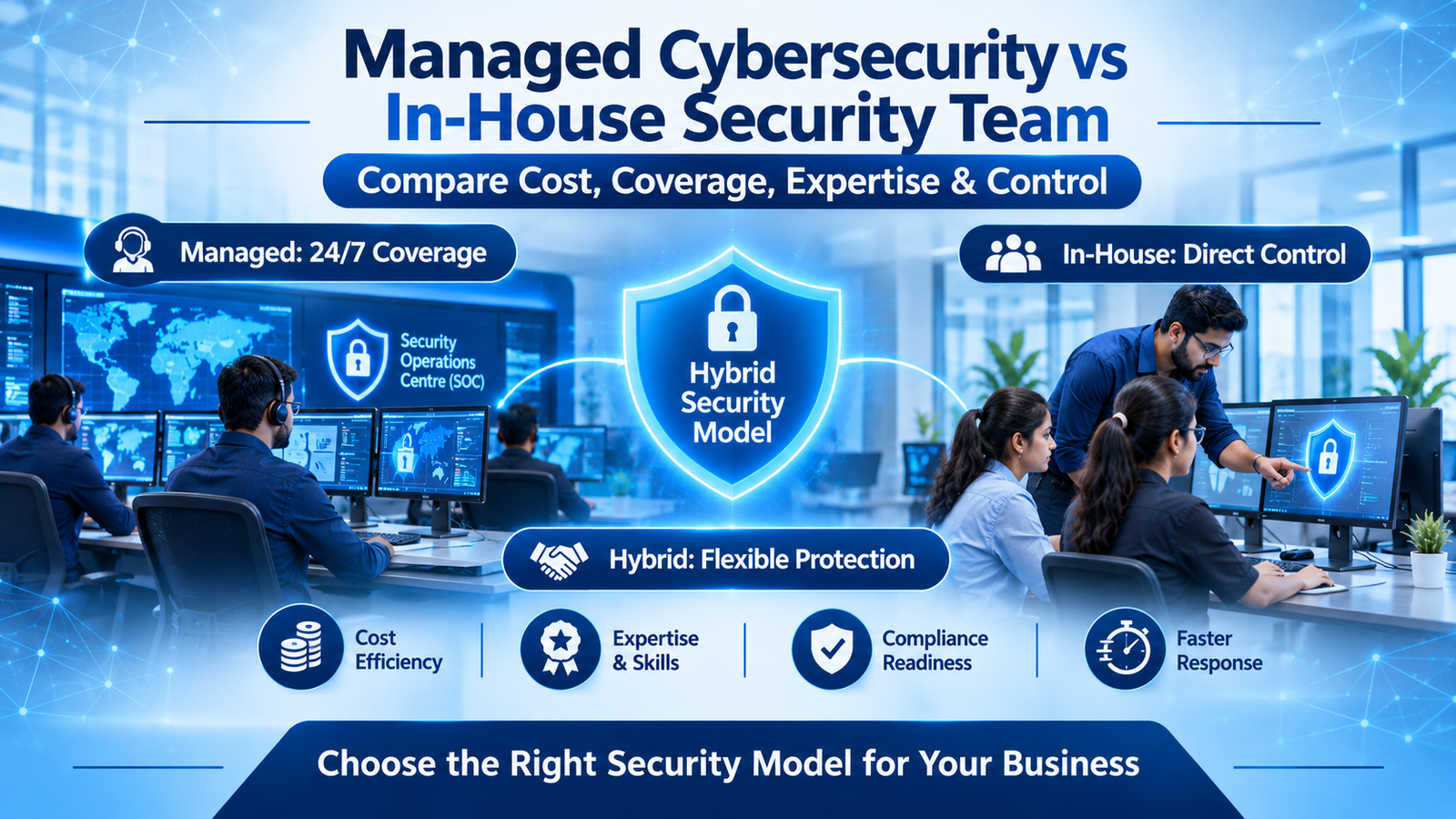
Managed cybersecurity services suit organisations that want round-the-clock monitoring without hiring a full team. An in-house team makes sense for large enterprises with complex infrastructure. Many Indian businesses end up in the middle with a hybrid setup: a small internal group, with 24/7 monitoring and incident response handled by an external provider.
These are security operations handled by an outside vendor under a service agreement. A standard package usually covers:
Because these vendors protect clients across the country, cybersecurity services in India often draw on shared threat intelligence from many industries.
An in-house team is made up of full-time employees whose job is protecting your systems. It typically includes:
You get direct oversight and people who know your workflows well. The trade-off is steady, ongoing cost.
An internal team means paying for salaries, recruiting, training, software licences, and retention. Managed providers spread tooling and staffing costs across their clients, so they usually charge a predictable monthly fee.
Experienced security professionals are hard to find in India, and hiring is slow. Managed providers already employ specialists in digital forensics, cloud security, and threat hunting. An internal team learns your technology well but can lack a broader view across industries.
Attackers don’t stop at 6 PM. Managed services generally monitor continuously. Smaller internal teams often cover only business hours, which leaves gaps overnight and on long weekends.
Internal teams have full authority over data, tools, and decisions. If you outsource, spell out access permissions, data-handling rules, and escalation paths in the contract.
Indian companies need to follow the Digital Personal Data Protection Act, 2023, and CERT-In directions, which require reporting certain cyber incidents within six hours. Banking and insurance face additional sector rules. Either model can keep you compliant if your processes are documented and tested regularly.
Thane brings together industrial estates, IT parks, hospitals, and fast-growing startups, and most local demand comes from these sectors. Local providers can also offer on-site visits, faster physical response, and familiarity with regional compliance needs. Since Thane sits inside the Mumbai Metropolitan Region, companies can also reach specialists and vendors across Mumbai and Navi Mumbai.
Choose managed cybersecurity services if:
Choose an in-house team if:
Consider a hybrid model if:
Put every option through these five questions:
What are managed cybersecurity services?
They’re outsourced security operations, including continuous monitoring, threat detection, and incident response, delivered by a specialist vendor under a contract.
Are cybersecurity services in India cheaper than an in-house team?
Often, for small and mid-sized companies, because vendors share software and staffing costs across clients. Large enterprises may find an internal team more economical at scale.
Where can I find cybersecurity services in Thane?
Start with local cybersecurity firms, managed service providers, and IT consultancies in Thane and the wider Mumbai area, then compare certifications and response times.
What does CERT-In require from Indian organisations?
CERT-In directions require reporting specified cyber incidents within six hours and keeping system logs for a set period.
Is a hybrid security model a good option?
Yes, often. It keeps strategic oversight in-house while an outside team handles 24/7 monitoring, balancing control, budget, and coverage.
How do managed cybersecurity services improve compliance?
Providers supply audit-ready documentation, policy guidance, and continuous monitoring, which makes it easier to show your controls meet DPDP Act and ISO 27001 standards.
How many security staff does an in-house SOC need?
A real 24/7 SOC needs several analysts working in shifts, plus security engineers and a manager. That’s why smaller firms often outsource.


 Home
