It often takes only one hurried decision for a phishing attack to succeed.
An employee receives an email that appears to come from the finance head. A payment needs to be approved before the end of the day. The message looks familiar, the request feels urgent, and the employee is already handling several other tasks. Instead of checking the sender’s address or confirming the request by phone, the employee clicks.
This is the gap simulated phishing is designed to address. Most employees have heard the usual advice about suspicious links, unexpected attachments, and unfamiliar senders. The challenge is remembering that advice when a message looks convincing and arrives at exactly the wrong moment.
An Anti-phishing company in India can create controlled exercises that reflect the situations employees genuinely face. When these exercises support a broader Security Awareness Training Program in India, employees get an opportunity to practise safer decisions without the consequences of a real attack.
The exercise should never feel like a trap. Its value comes from showing employees how phishing works and helping them respond differently the next time.
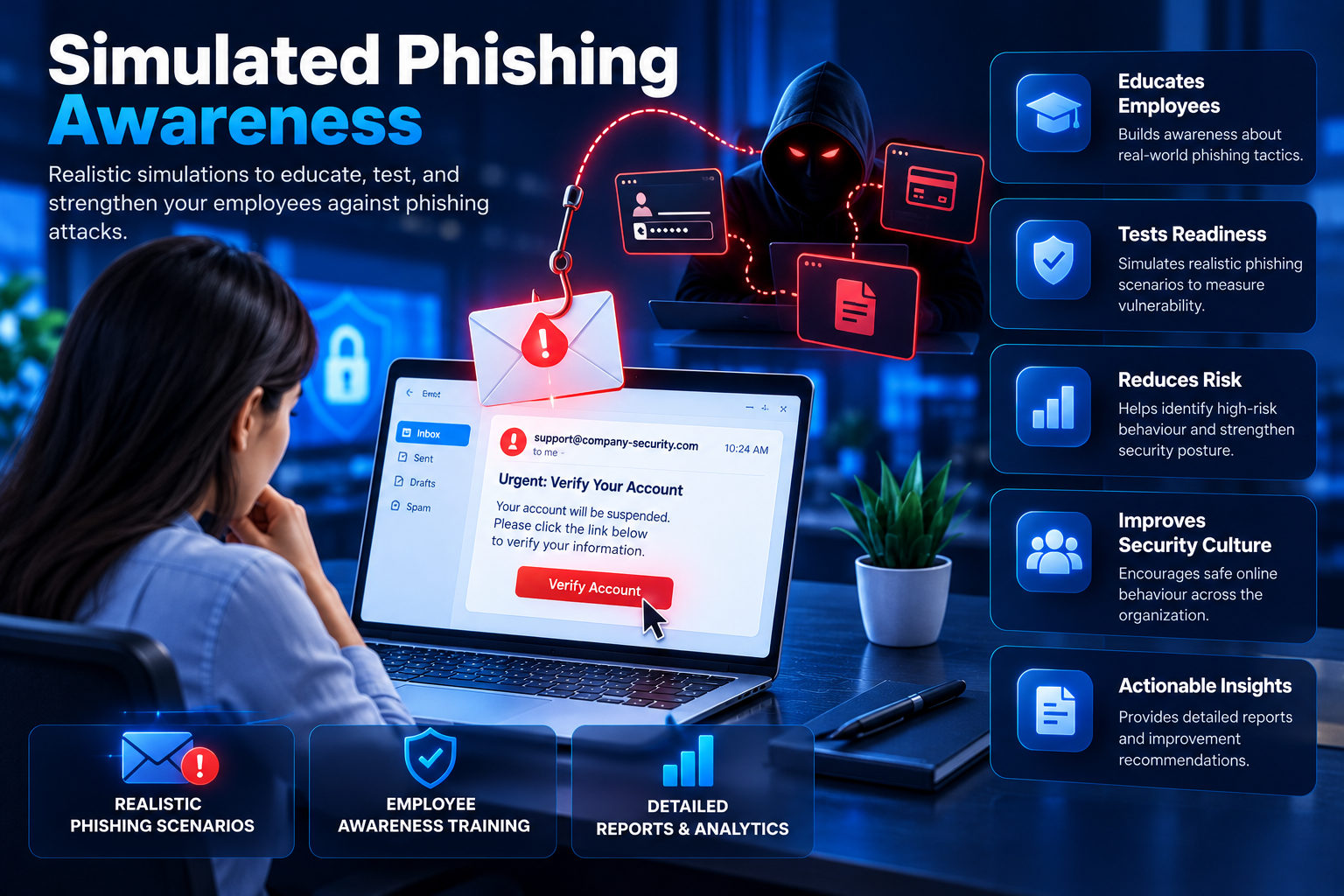
Falling for a phishing email does not necessarily mean someone is careless or poorly trained. Attackers succeed because they understand how people behave under pressure.
Urgency is one of their most effective tools. Messages such as “Your password expires today” or “This invoice requires immediate approval” encourage the recipient to act before checking.
Authority is another common tactic. Employees may be less likely to question a request that appears to come from a senior manager. Curiosity, fear, familiarity, and the desire to help can influence decisions in similar ways.
A simulated campaign allows employees to experience these tactics in a real working environment. That matters because recognizing a phishing example during a training session is different from recognizing one between meetings, calls, and deadlines.
The purpose of repeated simulations is not simply to reduce clicks. It is to create a short pause between receiving a message and acting on it.
During that pause, an employee might check the complete sender address, hover over a link, question an unusual request, or contact the supposed sender through another channel.
Over time, employees can learn to ask themselves:
A practical Security Awareness Training Program in India reinforces this behaviour through short lessons and relevant examples. The aim is not to make people distrust every email. It is to make verification feel like a normal part of work.
A single phishing template will not teach every employee equally well.
Someone in finance is more likely to face payment fraud, false invoices, or requests to change bank details. HR employees may receive harmful résumés or fake requests for employee information. IT teams often encounter false access alerts, while senior executives may be targeted through carefully researched impersonation attempts.
Remote employees face their own risks. A fake VPN warning, cloud-storage notification, or meeting invitation can look completely ordinary when much of the working day already happens online.
An Anti phishing company in India can build exercises around these differences. This makes the training more relevant and produces clearer information about where risk actually exists.
The results may show, for example, that employees recognize fake password alerts but struggle with messages appearing to come from trusted suppliers. The next round of training can then address that specific weakness instead of repeating generic advice.
Imagine being told a month later that you clicked a simulated phishing email. You may not remember the message, what you were doing, or why it appeared believable.
Immediate feedback is more useful. A short page can show the employee exactly what was missed: a changed domain name, an unusual sender address, a misleading button, or language designed to create panic.
Effective feedback answers four straightforward questions:
The tone matters. Employees are unlikely to learn from material that embarrasses or lectures them. An experienced Anti phishing company in India should use clear, respectful language and avoid unnecessary technical detail.
A mistake made during a simulation can become one of the most memorable parts of a Security Awareness Training Program in India, provided the employee understands what happened and how to improve.
Avoiding a click is useful. Reporting the email is even more valuable.
When an employee reports a suspicious message quickly, the security team can investigate the sender, block dangerous links, remove similar emails from other inboxes, and warn colleagues. One report may prevent several other people from interacting with the same attack.
Businesses should therefore look beyond click rates. Reporting rate and reporting speed can reveal whether employees know what to do after identifying a suspicious message.
The reporting process needs to be simple. If employees must complete a long form or search for the correct security contact, many will delete the email and move on.
A Security Awareness Training Program in India should explain the reporting process clearly and confirm that submitted reports are reviewed. Employees should also feel comfortable reporting an accidental click. Hiding a mistake creates far more risk than admitting it quickly.
Simulation data is valuable only when it is interpreted fairly.
A person who clicks once is not automatically a high-risk employee. The difficulty of the scenario, the employee’s role, the timing of the message, and previous performance all provide useful context.
Organizations can review:
An Anti phishing company in India should help the organization identify patterns rather than focus on isolated mistakes. Results can guide future training, but they may also reveal process problems.
If several finance employees respond to an unusual payment request, for example, the business may need a clearer payment-verification process in addition to more awareness training.
Simulations should feel realistic, but realism needs limits. Fake messages about layoffs, serious illness, personal emergencies, or promised bonuses may attract attention, yet they can also damage employee trust.
HR, legal, privacy, IT, and management teams should agree on suitable boundaries before campaigns begin. The organization should collect only the information it genuinely needs and protect individual results.
A mature Security Awareness Training Program in India treats employees as partners in security. It does not describe them as the problem or expect them to compensate for weak systems.
Email filtering, multifactor authentication, endpoint protection, secure approval processes, access controls, monitoring, and incident response remain essential. Simulated phishing strengthens one layer of defence; it does not replace the others.
It gives employees realistic practice, helps them recognize manipulation tactics, reinforces verification habits, and teaches them how to report suspicious messages.
Many businesses run them monthly or quarterly. The appropriate schedule depends on risk, workforce size, previous results, compliance needs, and employee fatigue.
It may provide scenario design, campaign management, reporting, behavioural analysis, role-based exercises, multilingual learning materials, and follow-up recommendations.
Typical topics include phishing, passwords, social engineering, data handling, safe browsing, incident reporting, simulations, assessments, and role-specific risks.
Punishment can discourage honest reporting. Immediate feedback, focused coaching, and additional training are generally more effective.
No. It improves employee behaviour, but it must work alongside technical security, secure processes, monitoring, access controls, and incident response.


 Home
Home