Cyberattacks are becoming more sophisticated every year, but one factor continues to remain a major security challenge: human behaviour. Even organizations with advanced firewalls, endpoint protection, and monitoring systems can face data breaches when an employee unknowingly clicks a malicious link or shares sensitive information.
This is where phishing simulation plays an important role.
A phishing simulation is a controlled cybersecurity exercise that helps organizations test how employees respond to realistic phishing attempts. Instead of waiting for a real attack to expose weaknesses, companies can identify security gaps, improve employee awareness, and build stronger cyber defence practices in advance.
An Anti-phishing simulation company in India helps businesses evaluate employee readiness by creating realistic phishing scenarios, analysing responses, and providing security awareness recommendations. These simulations allow organizations to understand how prepared their workforce is against one of the most common cyber threats.
Unlike traditional cybersecurity solutions that mainly focus on protecting networks and devices, phishing simulations focus on strengthening the human layer of security.
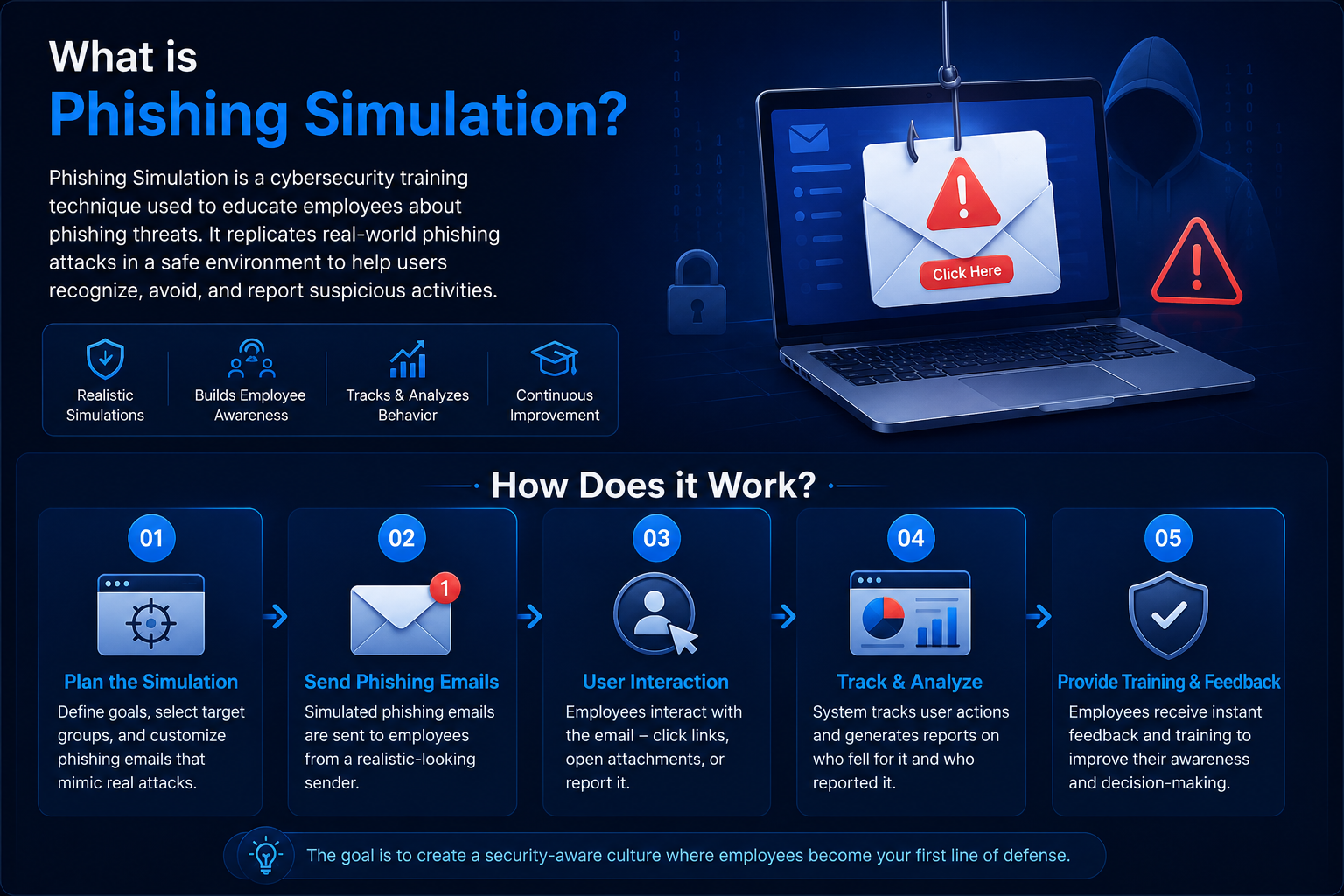
Phishing simulation is a cybersecurity awareness method where organizations send simulated phishing emails or messages to employees in a controlled environment. These messages imitate real-world attacks but are designed without causing actual harm.
The objective is not to trick employees or create fear. Instead, it helps employees recognize common phishing techniques and understand how attackers manipulate users.
Examples of simulated phishing attempts include:
The results help security teams understand employee behaviour and identify areas where additional awareness training may be required.
A professional Anti-phishing simulation company in India creates customized campaigns based on an organization's industry, employee roles, and existing security risks.
A phishing simulation program generally follows four important stages: planning, simulation creation, campaign execution, and employee training.
Before launching a simulation, cybersecurity teams first understand the organization's environment. This includes analysing:
For example, finance teams may be tested with simulated invoice fraud emails, while IT employees may receive scenarios involving fake account access alerts.
The goal is to make simulations realistic and relevant rather than using generic phishing examples.
The next step involves designing simulated attacks that closely resemble real phishing attempts. Cybersecurity teams consider factors such as:
Common simulation scenarios include:
Credential Theft Attempts
Employees receive a fake login page designed to test whether they verify URLs and sender details before entering credentials.
Business Email Compromise Scenarios
Employees may receive simulated messages appearing to come from senior executives requesting urgent actions, such as approving payments.
Account Security Alerts
These simulations imitate messages about password expiry, account suspension, or security verification requests.
The purpose is to help employees recognize the warning signs attackers commonly use.
After the scenarios are prepared, simulated phishing emails are sent to selected employees or departments. During the campaign, security teams monitor important metrics such as:
These insights help organizations measure their current phishing risk level and understand where additional awareness efforts are needed.
For example, a high reporting rate indicates that employees are identifying threats effectively, while repeated clicks may indicate the need for further training.
Training is one of the most valuable parts of phishing simulation. The purpose is not to punish employees who interact with simulated phishing emails. Instead, it is an opportunity to improve their ability to identify threats.
Employees learn:
Continuous learning helps create a stronger security culture where employees become an active part of cyber defence.
Phishing remains one of the most common methods used by cybercriminals because it targets people rather than technology.
Attackers often use social engineering techniques to create urgency, fear, or curiosity. A single successful phishing attempt can result in stolen credentials, financial losses, or unauthorized access to company data.
Phishing simulation helps organizations:
Regular testing ensures employees stay prepared as phishing techniques continue to evolve.
An Anti-phishing simulation company in India provides specialized cybersecurity awareness services designed to test and improve employee security behaviour.
These companies typically help organizations with:
Businesses across industries such as banking, healthcare, IT services, manufacturing, and education use phishing simulations to reduce risks associated with human error.
Email Phishing Simulation
The most common type where employees receive simulated phishing emails to test their ability to identify suspicious messages.
Spear Phishing Simulation
These are highly targeted simulations designed around specific employees, departments, or business functions.
Business Email Compromise Simulation
These tests focus on impersonation attacks involving executives, vendors, or financial requests.
Credential Harvesting Simulation
These exercises evaluate whether employees can identify fake login pages designed to capture usernames and passwords.
Organizations should follow these practices to achieve better results:
The goal should always be improving security awareness, not testing employees unfairly.
Before choosing an Anti-phishing simulation company in India, organizations should evaluate:
The right partner should help organizations understand their risks and develop measurable improvements in security awareness.
1. What is phishing simulation?
Phishing simulation is a controlled cybersecurity exercise where organizations create fake phishing attacks to test employee awareness and improve their ability to identify real threats.
2. How does phishing simulation work?
It works by sending simulated phishing messages, analysing employee responses, measuring risk levels, and providing awareness training based on results.
3. Why do companies use phishing simulation?
Companies use phishing simulations to reduce human-related security risks, improve employee awareness, and prepare teams for real cyber threats.
4. Is phishing simulation safe?
Yes. Phishing simulations are controlled exercises and do not contain real malware or harmful links. They are designed only for testing and education.
5. How often should organizations conduct phishing simulations?
Most organizations conduct simulations periodically throughout the year to maintain awareness and track improvement.
6. What happens if an employee clicks a simulated phishing email?
The employee receives guidance explaining the phishing indicators they missed and learns how to identify similar threats in the future.
7. Can small businesses benefit from phishing simulation?
Yes. Small businesses can also benefit because attackers frequently target organizations of all sizes through phishing and social engineering attacks.
For comprehensive Security Awareness Training and simulation tools, please visit Cyber Security Service Provider.


 Home
Home