Indian businesses now rely on interconnected digital systems. A portal, API, cloud account, or vendor connection can introduce a weakness that attackers use to steal data, interrupt work, commit fraud, or enter restricted systems. Vulnerability Assessment & Penetration Testing in India helps organizations find these gaps early and understand which ones could cause business harm.
A VAPT service in India brings together two related activities. Vulnerability assessment looks broadly for known flaws, unsafe configurations, missing patches, and exposed services. Penetration testing then examines selected findings to see whether an attacker could gain access or move between systems. That practical evidence helps teams decide what needs immediate attention and what can be scheduled later. VAPT matters to large enterprises, but it is equally relevant to smaller businesses handling payments, customer records, intellectual property, or services that cannot afford downtime.
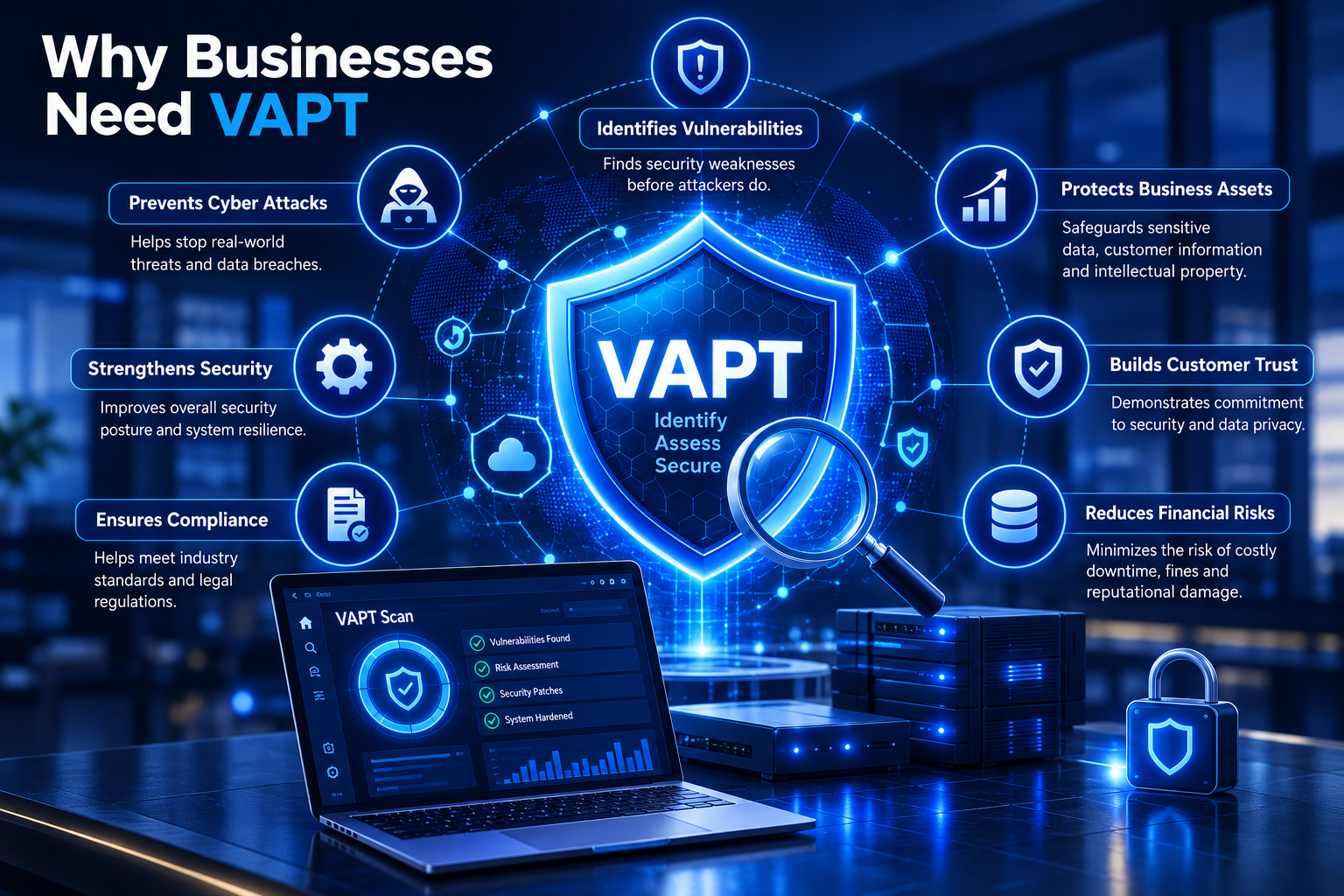
VAPT is a structured security testing process covering networks, applications, APIs, cloud resources, mobile apps, wireless environments, and other approved assets. Its purpose is to discover weaknesses, validate their practical impact, and provide clear remediation guidance.
A typical VAPT service in India may include:
The final report should tell technical teams what needs fixing and give decision-makers an honest view of the organization’s exposure.
Businesses frequently add cloud services, customer portals, payment integrations, APIs, and remote-working tools. Assets may be launched quickly, misconfigured, forgotten, or left unpatched. Vulnerability Assessment & Penetration Testing in India creates a structured way to review this changing environment and identify security gaps that routine monitoring may miss.
Consider an online retailer whose payment system becomes unavailable during a busy weekend. Even a brief interruption can delay orders, increase support calls, and reduce customer confidence. VAPT helps uncover the technical path that could cause such disruption before it is used in a real attack.
Companies may store personal data, financial records, login credentials, health information, employee files, or intellectual property. Weak access controls, exposed databases, insecure APIs, and unpatched software can place this information at risk. A VAPT service in India helps verify whether controls restrict unauthorized access.
Requirements vary by industry, customer contract, and the type of information a business handles. Some organizations need documented testing for payment security, internal governance, audits, or sector-specific obligations. A VAPT report can provide evidence of testing and remediation, but a report alone does not prove that every system is secure.
Scanners are useful for finding known patterns, but they do not understand how a business process is supposed to work. They may miss excessive permissions, authorization errors, or several minor flaws that become serious when combined. Vulnerability Assessment & Penetration Testing in India therefore needs manual investigation alongside automated checks.
The appropriate schedule depends on business risk, asset exposure, change frequency, and compliance obligations. Vulnerability scanning may be monthly, quarterly, or continuous, while penetration testing is often performed annually.
Additional testing should be considered:
Vulnerability Assessment & Penetration Testing in India should form part of an ongoing security programme rather than being treated as a one-time certificate.
An incomplete scope can produce a reassuring report while leaving critical assets untested. Businesses should identify domains, IP addresses, applications, APIs, cloud resources, mobile platforms, wireless networks, user roles, and third-party dependencies.
Before appointing a VAPT service in India, confirm the testing methodology, manual-testing depth, permitted techniques, data-handling rules, escalation process, reporting format, and retesting terms. The engagement should also define emergency contacts and conditions for pausing testing if operational risk appears.
VAPT identifies security weaknesses, validates exploitable risks, supports remediation, and helps protect data, systems, operations, and stakeholder relationships.
It may include network, application, API, mobile, cloud, configuration, and manual penetration testing, followed by reporting and retesting.
Testing is commonly annual, with more frequent vulnerability assessments and additional tests after major changes, launches, integrations, or incidents.
No. Scanners find known patterns efficiently, but manual testing is needed to identify business-logic, authorization, and chained vulnerabilities.
Duration depends on the number, type, and complexity of assets. Small scopes may take days; complex environments may require weeks.
No. VAPT evaluates an agreed scope at a particular time. Continuous monitoring, secure development, patching, access control, and retesting remain necessary.


 Home
Home